Meowdoku vs Other Puzzle Games — What Sets It Apart
A detailed comparison of Meowdoku against Sudoku, Minesweeper, Nonograms, and other popular logic puzzles. See what makes this cat-themed game truly unique.
Meowdoku vs Classic Sudoku
At first glance, Meowdoku and Sudoku share obvious DNA — both are grid-based logic puzzles where each row and column must contain unique elements. But the similarities end there, and the differences are what make Meowdoku a fresh experience even for Sudoku veterans.
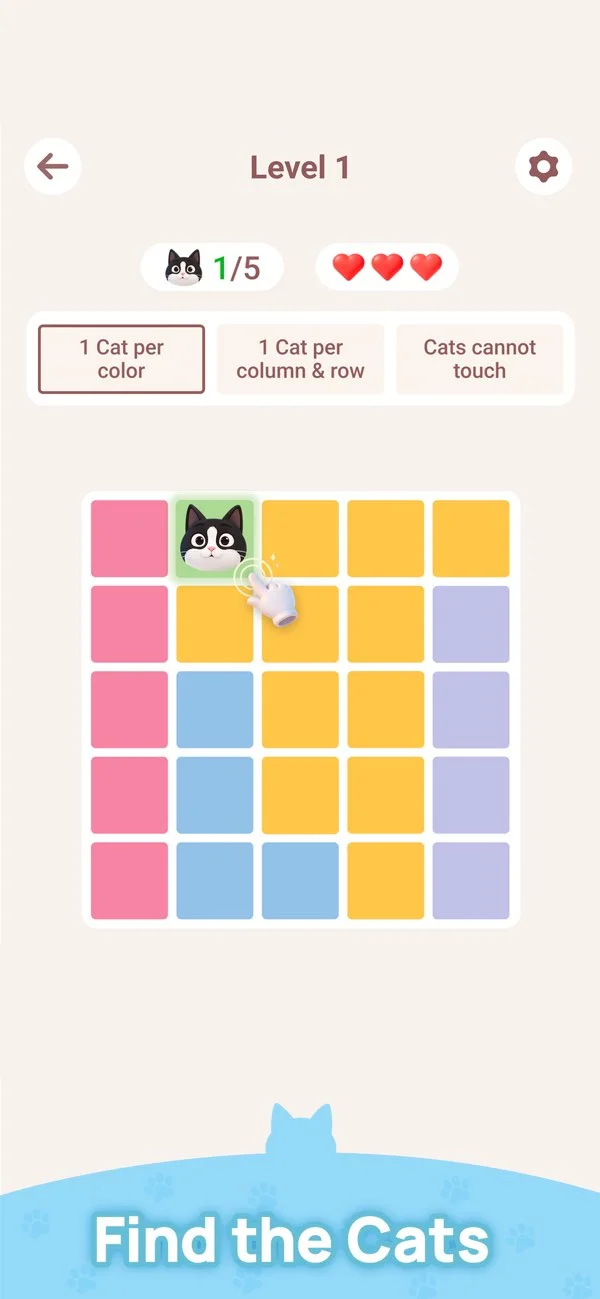 Meowdoku swaps numbers for cats and rigid boxes for colorful irregular regions
Numbers vs Cats: Sudoku uses numbers 1–9, which can feel abstract and mathematical. Meowdoku replaces numbers with adorable cats — the same logical constraint, but wrapped in a warm, approachable theme that appeals to players who might find traditional Sudoku intimidating.
3×3 Boxes vs Irregular Regions: Sudoku's rigid 3×3 box structure is predictable. Meowdoku's colored regions come in wildly varying shapes and sizes — some tiny 2-cell pockets, others sprawling across the board. This irregular geometry creates unique deduction challenges that no Sudoku puzzle can replicate.
The Diagonal Rule: This is Meowdoku's killer feature. Sudoku has no diagonal constraints at all — two identical numbers can sit diagonally adjacent without issue. In Meowdoku, diagonal adjacency is forbidden, creating a spatial dimension that fundamentally changes how you approach the puzzle. It's the difference between chess and checkers.
Difficulty Progression: Sudoku difficulty is primarily driven by the number of given digits. Meowdoku difficulty scales through board size, region complexity, and the density of inter-region constraints — a more organic and varied difficulty curve.
Meowdoku vs Minesweeper
Minesweeper players will feel right at home with Meowdoku's spatial deduction, but the two games solve very differently.
Flagging vs Marking: In Minesweeper, you flag cells you believe contain mines. In Meowdoku, you mark cells that cannot contain cats — an inversion of the same concept. Both games use this visual aid system, but Meowdoku's marking serves a deductive purpose (eliminating possibilities) rather than a memorial one (remembering mine locations).
Hearts vs Mines: Minesweeper's single mistake is fatal — one wrong click and the game is over. Meowdoku's hearts system gives you three chances per puzzle, making it more forgiving and encouraging of exploration. This fundamentally changes the psychological experience from "don't mess up" to "think carefully, but it's okay to learn."
Region Constraints vs Number Hints: Minesweeper gives you numerical clues about adjacent mines. Meowdoku gives you colored region constraints. While both are forms of local information, Meowdoku's region system is global — every cell belongs to exactly one region, creating a complete covering of the board that enables holistic deduction strategies impossible in Minesweeper.
Meowdoku vs Nonograms (Picross)
Nonograms use row and column number clues to reveal a hidden pixel art image. Meowdoku flips this concept — instead of numbers telling you where to fill cells, region constraints and spatial rules tell you where to place cats.
Grid Types: Nonograms use a uniform rectangular grid. Meowdoku's irregular region overlay on top of the grid creates a dual-layer puzzle — you must satisfy both the grid-level constraints (row, column, diagonal) and the region-level constraint (one cat per zone).
Solving Logic: Nonograms are solved through arithmetic and pattern completion. Meowdoku is solved through spatial deduction and constraint satisfaction. If you enjoy the "A-ha!" moment of deduction, Meowdoku delivers it more frequently than Nonograms.
💡 Which Puzzle Suits You? If you love methodical, step-by-step logic, try Sudoku or Nonograms. If you enjoy spatial reasoning and "chain reaction" deductions, Meowdoku will be your new favorite. The diagonal rule creates a unique solving rhythm that no other puzzle genre captures.
Why Players Love Meowdoku Most
Beyond the mechanics, Meowdoku wins hearts (pun intended) through its complete package: charming cat theme, satisfying haptic feedback, pure logic guarantee (no guessing ever), zero math required, complete offline play, and the daily community aspect that connects players worldwide through a shared puzzle. It's not just a game — it's a daily ritual that sharpens your mind and brightens your day.
More Meowdoku Guides
Explore more articles to level up your Meowdoku skills: