Meowdoku Rules — The Complete Mechanics Guide
A deep dive into every rule that governs Meowdoku gameplay. Understand the logic behind each mechanic and never lose a heart again.
The 4 Core Rules of Meowdoku
At its heart, Meowdoku is governed by just four fundamental rules. Master these and you'll have the foundation to solve every puzzle the game throws at you — from the easiest beginner board to the most complex expert challenge.
Rule 1: One Cat Per Colored Region
Each colored zone on the board must contain exactly one cat — no more, no less. Regions come in various shapes and sizes, from tiny 2-cell areas to sprawling zones that span much of the board. This rule is your primary guide: start each puzzle by scanning all regions and noting which ones have the fewest possible cells. The smaller the region, the easier it is to deduce the correct placement.
Strategy Note: When a region has only one unblocked cell remaining, that cell must contain a cat. This is the simplest and most common deduction in Meowdoku — learn to spot these forced placements instantly.
Rule 2: No Two Cats in the Same Row or Column
Cats are fiercely territorial about their sightlines. No two cats can share the same row or same column. Think of it like chess rooks — each cat demands its own unique row and column on the board. This rule creates a powerful constraint: once you place a cat, you can immediately eliminate every other cell in that entire row and column from consideration.
Strategy Note: After each placement, mentally scan the row and column. Any remaining regions that overlap with that row or column now have one fewer possible cell — sometimes this alone forces the next deduction.
Rule 3: No Diagonal Contact Between Cats
This is the rule that makes Meowdoku truly unique. Cats cannot touch each other even diagonally — meaning every cat needs a personal space bubble of all 8 surrounding cells. This constraint is far more powerful than it first appears. A single cat blocks not just its row and column, but 8 adjacent cells as well. On a small board, one well-placed cat can eliminate a huge portion of possible positions.
Strategy Note: The diagonal rule is where most deduction chains begin. When two regions are diagonally adjacent, their cats must be placed on opposite sides — creating a ripple effect of forced placements across the board.
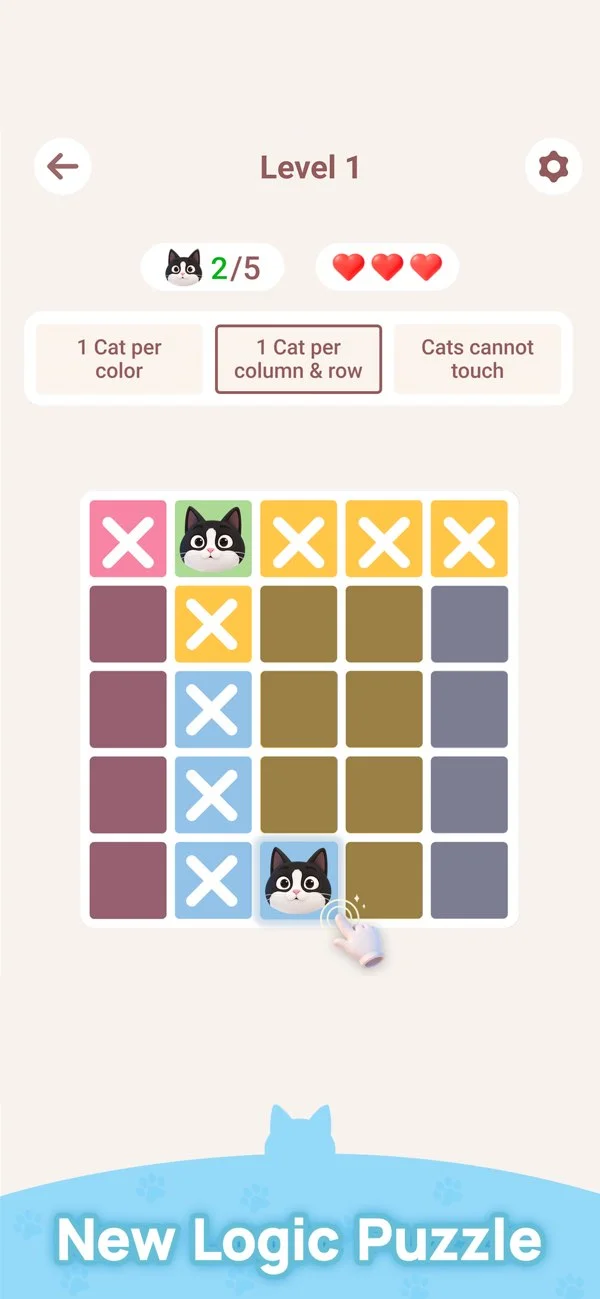 The diagonal rule in action — cats maintain personal space in all directions
Rule 4: Pure Logic — No Guessing Required
Every single Meowdoku puzzle is 100% solvable through deductive reasoning alone. There is no randomness, no hidden information, and no luck involved. If you find yourself guessing where to place a cat, you've missed a logical deduction somewhere on the board. Take a step back, re-scan all regions, rows, columns, and diagonal constraints — the answer is always there.
Strategy Note: When stuck, systematically review each region from smallest to largest. Check row/column availability for each cell in the region. The solution will reveal itself through the process of elimination.
Understanding the Hearts System
Meowdoku gives you 3 hearts (lives) per puzzle. Each time you place a cat in an invalid position — meaning it violates any of the four core rules — you lose one heart. Lose all three and the puzzle ends, requiring a restart.
The hearts system isn't meant to punish you — it's designed to encourage careful, logical thinking over random guessing. Each heart loss is feedback: your placement violated a rule, and understanding which rule you broke is the key to improving. Many experienced players view hearts not as lives but as learning opportunities.
When you lose a heart, the game highlights the conflict that caused it. Pay attention to this feedback. Was it a row conflict? A diagonal touch? Understanding the pattern of your mistakes is the fastest way to eliminate them from your gameplay.
💡 Pro Tip: Think of hearts as a learning tool, not a punishment. After losing a heart, pause and identify exactly which rule you violated. Players who do this consistently improve 3x faster than those who just restart immediately.
Board Sizes and Difficulty Progression
Meowdoku features puzzles across a range of board sizes and difficulty levels. Beginners typically start on smaller boards (4×4 or 5×5 grids) with fewer regions and simpler layouts. As you progress, boards grow larger — up to 8×8 or beyond — with more regions, more complex shapes, and trickier deduction chains.
Difficulty Factors: Puzzle difficulty isn't just about board size. The shape and arrangement of colored regions play a huge role. Long, snake-like regions that span multiple rows and columns create more complex constraints. Regions clustered closely together require more careful diagonal analysis. As you advance, you'll encounter puzzles where a single placement triggers cascading deductions across the entire board.
Progression Path: The game naturally scales difficulty as you complete puzzles. Don't rush to the hardest boards — each difficulty level teaches specific deduction patterns that you'll need for the next tier. Mastering each level thoroughly builds the mental toolkit required for expert puzzles.
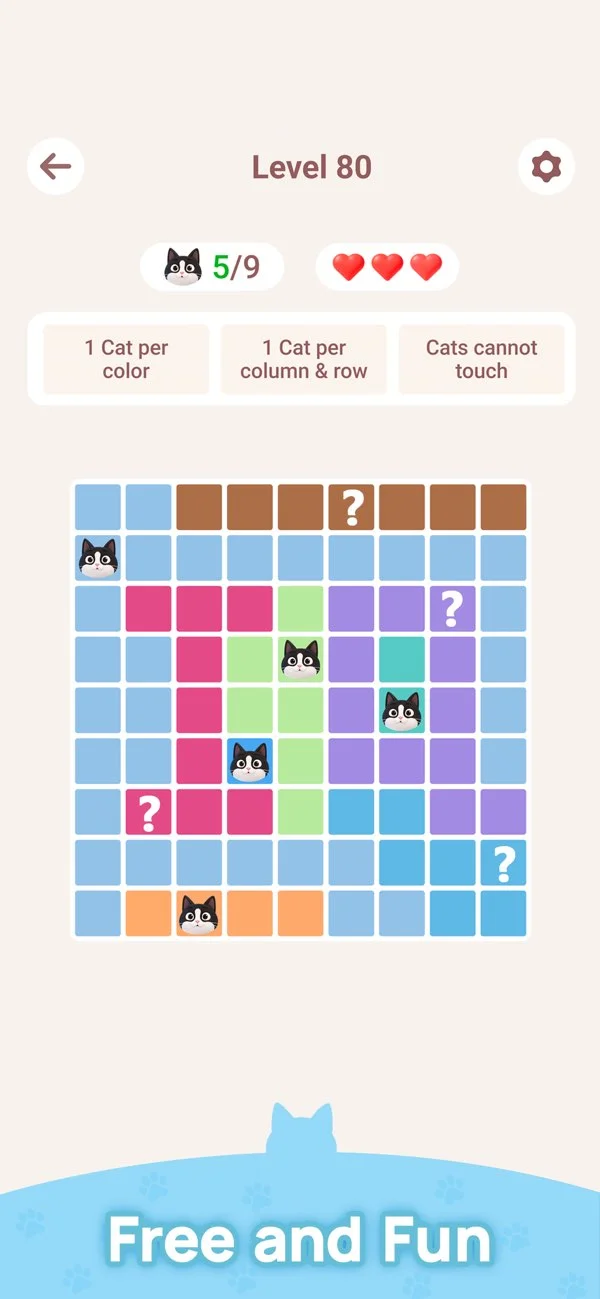 From simple to expert: Meowdoku's difficulty progression keeps every puzzle fresh
More Meowdoku Guides
Explore more articles to level up your Meowdoku skills: