Meowdoku Advanced Strategies — Solve Like an Expert
Ready for harder puzzles? These advanced techniques will transform your solving approach and help you conquer even the most challenging Meowdoku boards.
Region-First Solving Strategy
As puzzles grow more complex, how you order your analysis becomes just as important as the analysis itself. The region-first strategy is the most reliable approach for tackling medium-to-hard Meowdoku puzzles.
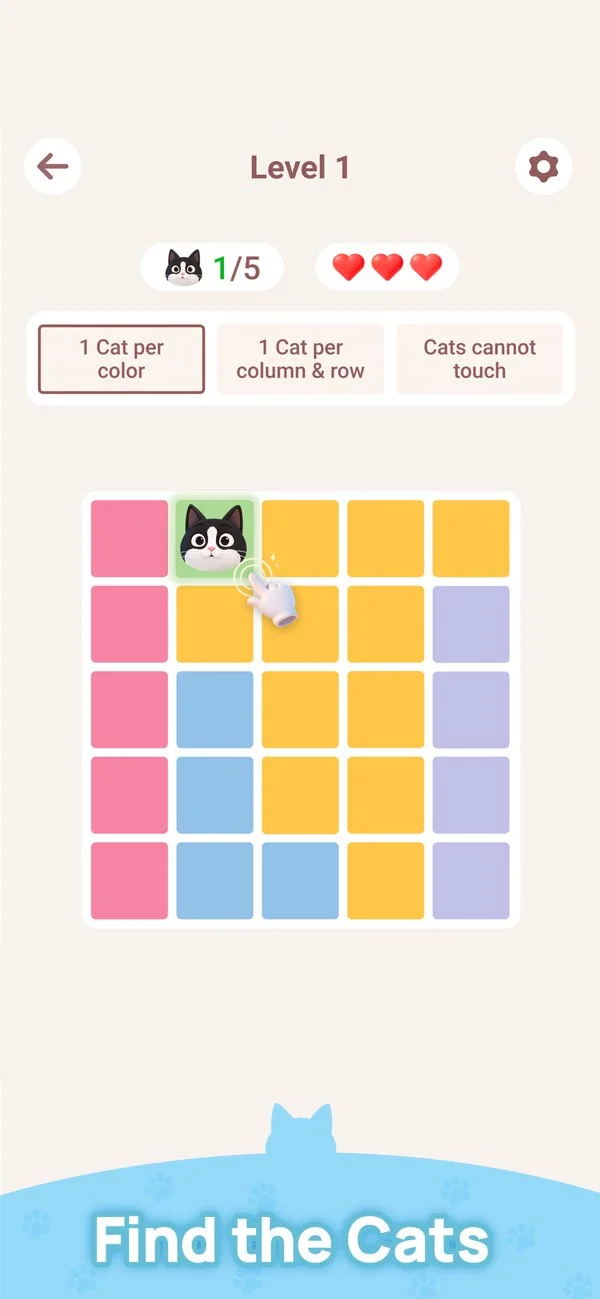 Region-first strategy: analyze the smallest colored regions to find forced placements
- 1Sort Regions by Cell Count
Before placing any cats, scan the entire board and mentally rank every region from smallest to largest. A 2-cell region is your highest priority — it has the fewest possibilities and often yields a forced placement immediately.
- 2Check Each Cell's Constraints
For the smallest region, examine each cell individually. Does its row already have a cat? Its column? Are any of its 8 adjacent cells occupied? Cross out impossible cells until only one remains.
- 3Propagate Placements Immediately
After placing a cat, immediately update your mental map: block its row, column, and all diagonal neighbors. Then re-check the smallest remaining region — it may now have a forced placement.
- 4Iterate Until Solved
Repeat this cycle — smallest region, constraint check, placement, propagation — until the board is complete. This systematic approach ensures you never miss an obvious deduction.
Constraint Propagation Technique
Constraint propagation is the bread and butter of expert-level Meowdoku solving. The idea is simple but powerful: every cat placement creates a chain reaction of deductions across the board.
Here's a practical example: Imagine you place a cat in the center of an 8×8 board. That single placement immediately blocks: all cells in its row (7 blocked), all cells in its column (7 blocked), and all 8 diagonally adjacent cells. If these blocked cells overlap with small regions, those regions may now have only one possible cell remaining — forcing another cat placement, which triggers another chain, and so on.
How to practice: On your next puzzle, after each placement, pause and verbally list every cell that just became impossible. Count how many regions are affected. With practice, this mental exercise becomes automatic, and you'll start "seeing" deduction chains before you even place a cat.
💡 Pro Tip: The most common mistake in constraint propagation is forgetting the diagonal rule. Always check all 8 surrounding cells — diagonal constraints often trigger the longest deduction chains in expert puzzles.
Candidate Elimination Method
When direct deduction stalls, the candidate elimination method takes over. For each region, list every cell that could still contain a cat (considering all row, column, and diagonal constraints). Then systematically eliminate candidates by cross-referencing with other regions.
For example, if Region A has two possible cells, and both are in the same row, then no other region can place a cat in that row. This cross-region elimination is where advanced puzzles get interesting — you're no longer just solving one region at a time, but reasoning about how regions interact with each other.
Using the Marking Tool: The in-game marking feature is essential for candidate elimination. Mark cells that are definitely blocked (by row/column/diagonal) with one symbol, and use a different mental category for cells that are "possibly available." This visual layering lets you process complex boards without overloading your working memory.
Pattern Recognition for Speed Solving
After solving hundreds of puzzles, you'll start recognizing common board patterns that repeat across different puzzles. Here are the most valuable ones to learn:
- Corner Regions: Regions in board corners have fewer adjacent cells, making diagonal constraints simpler. They're often the best starting point on large boards.
- Edge Regions: Regions along board edges have 5 adjacent cells instead of 8, reducing constraint complexity. Prioritize edge regions after corners.
- Isolated Regions: A region completely surrounded by already-blocked cells is essentially solved — only one placement is possible. Learn to spot these instantly.
- Chain Regions: Two or more regions connected through shared rows or columns. Solving one forces constraints on the other, creating a domino effect.
More Meowdoku Guides
Explore more articles to level up your Meowdoku skills: