25 Meowdoku Tips & Tricks for All Skill Levels
From day-one basics to expert-level optimization — this comprehensive collection of 25 tips will sharpen every aspect of your Meowdoku gameplay.
Beginner Tips (1–10)
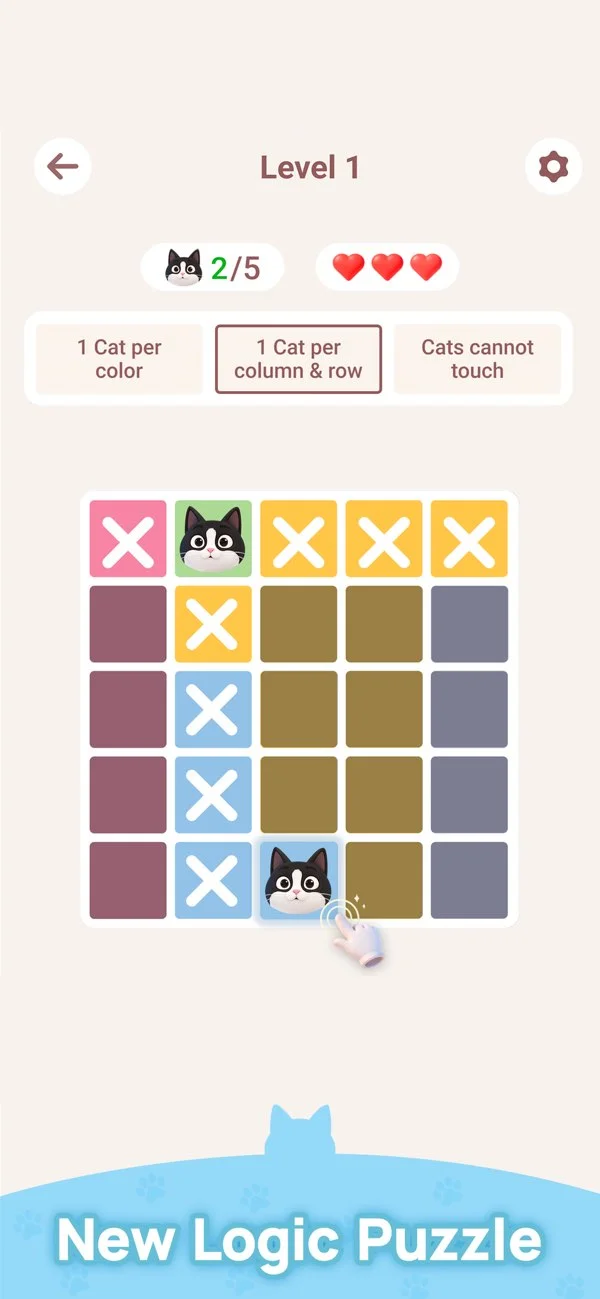 Master these beginner tips to build a solid Meowdoku foundation
Tip 1: Start with the smallest region. On every puzzle, scan for the colored zone with the fewest cells. A 2-cell or 3-cell region dramatically limits your options and often yields a forced placement on your very first move.
Tip 2: Use the marking tool from day one. Many beginners ignore marking, but it's the single most powerful tool for avoiding mistakes. Mark every cell that's blocked by an existing cat — this visual map prevents costly heart losses.
Tip 3: Always check diagonals. The diagonal rule is what trips up most new players. After every placement, mentally verify that all 8 surrounding cells are cat-free. Make this a habit and you'll cut your heart losses by 70%.
Tip 4: Never guess. Meowdoku puzzles are 100% logic-solvable. If you're about to place a cat without a clear deductive reason, stop. There's a clue you're missing. Step back and re-scan the board.
Tip 5: Learn from every heart loss. When you lose a heart, don't just restart — study why. Which rule did you violate? Understanding your mistake pattern is the fastest path to improvement.
Tip 6: Scan regions before placing any cats. Take 10 seconds at the start to understand the board layout. Which regions overlap? Which are isolated? This upfront investment pays dividends in faster solves.
Tip 7: Verify before you double-tap. A 2-second check — row clear? column clear? diagonals clear? — prevents 90% of beginner mistakes. Speed comes later; accuracy first.
Tip 8: Take breaks between puzzles. Mental fatigue is real in logic games. If you lose hearts on two consecutive puzzles, take a 5-minute break. Your brain processes deduction patterns subconsciously during rest.
Tip 9: Complete the in-game tutorial. Even if you're an experienced puzzle gamer, the Meowdoku tutorial covers game-specific mechanics (especially the diagonal rule) that differ from other puzzle games.
Tip 10: Practice daily. Consistency beats intensity. 10 minutes of Meowdoku every day builds pattern recognition faster than 2-hour marathon sessions once a week.
Intermediate Tips (11–18)
Tip 11: Master chain deductions. When you place a cat, don't just move on — check which regions are now constrained. One placement often forces another, which forces another. Following these chains is where speed comes from.
Tip 12: Prioritize regions by constraint density. A small region in a crowded area of the board (surrounded by other regions) is higher priority than a small region in an open area. More constraints mean fewer possibilities.
Tip 13: Exploit corner regions. Regions in board corners have fewer diagonal neighbors (only 3 instead of 8), making them easier to solve. Start with corners when available.
Tip 14: Use edge constraints strategically. Regions along board edges have only 5 diagonal neighbors. Edge regions are your second priority after corners.
Tip 15: Develop color-coding awareness. Train yourself to instantly associate each color with its region. The faster you can mentally map colors to zones, the faster you'll spot forced placements.
Tip 16: Balance speed and accuracy. Find your personal sweet spot. Some players solve fastest at 85% confidence; others need 95%. Experiment to find where your heart-loss rate stays under 1 per 3 puzzles.
Tip 17: Learn common region shapes. L-shaped regions, diagonal strips, and isolated pockets each have characteristic solving patterns. After 50+ puzzles, you'll start recognizing these instinctively.
Tip 18: Use undo strategically, not reactively. Undo isn't just for mistakes — use it to explore "what-if" scenarios. Place a cat, observe the resulting constraints, then undo if the deduction chain doesn't resolve. It's free exploration.
Advanced Tips (19–25)
Tip 19: Pre-scan the board in 5 seconds. Before your first placement, rapidly identify: the 2 smallest regions, any isolated regions, and any obvious forced placements. This mental map guides your entire solve.
Tip 20: Identify your blind spots. Everyone has them — some players miss row constraints, others miss diagonals. Review your last 20 heart losses and categorize the causes. Then drill your weakest area until it becomes a strength.
Tip 21: Time management for Daily Puzzle. The Daily Puzzle clock starts when you open it. Don't open it until you're ready to solve. Warm up with 1–2 easier puzzles first, then tackle the daily challenge at peak mental sharpness.
Tip 22: Memorize key patterns. Certain region configurations recur across puzzles. A 2-cell diagonal region, for example, always has exactly one valid placement once surrounding constraints are applied. Memorize these patterns for instant recognition.
Tip 23: Optimize your marking workflow. Pro players develop a rapid marking rhythm — long-press, swipe to next cell, long-press. Practice this until it's as natural as typing. Efficient marking can shave 20% off your solve time.
Tip 24: Know when to restart vs push through. If you've lost 2 hearts and have fewer than 3 cats placed, restart — the time penalty is minimal. If you've lost 1 heart with 80% of cats placed, push through carefully. Context matters.
Tip 25: Develop a competitive but healthy mindset. Leaderboard climbing is motivating, but Meowdoku is ultimately about enjoying the logic. The players with the longest streaks aren't the most competitive — they're the ones who genuinely love the daily ritual of solving.
More Meowdoku Guides
Explore more articles to level up your Meowdoku skills: